
AI Performance Studio · Mac-first · Private beta in development
Give the script a cast before you give it a production.
NarrativeForge™ trademark is the private AI cast and rehearsal studio for writers and directors. Hear the scene, direct the acting, preserve the performance through revisions, and keep writing where you already write.
A new creative category
Not a script reader with prettier voices. A performance studio that remembers the production.
NarrativeForge occupies the space between Final Draft and a live table read, between Scrivener and an audiobook studio, and between a director's interpretation and the cost of assembling a cast.
From the current build
Real interface captures strengthen the promise.
Alongside the interactive simulations, these screenshots show actual product direction already taking shape: a gentler opening experience, a guided audiobook flow, and a studio-level workspace for larger productions.
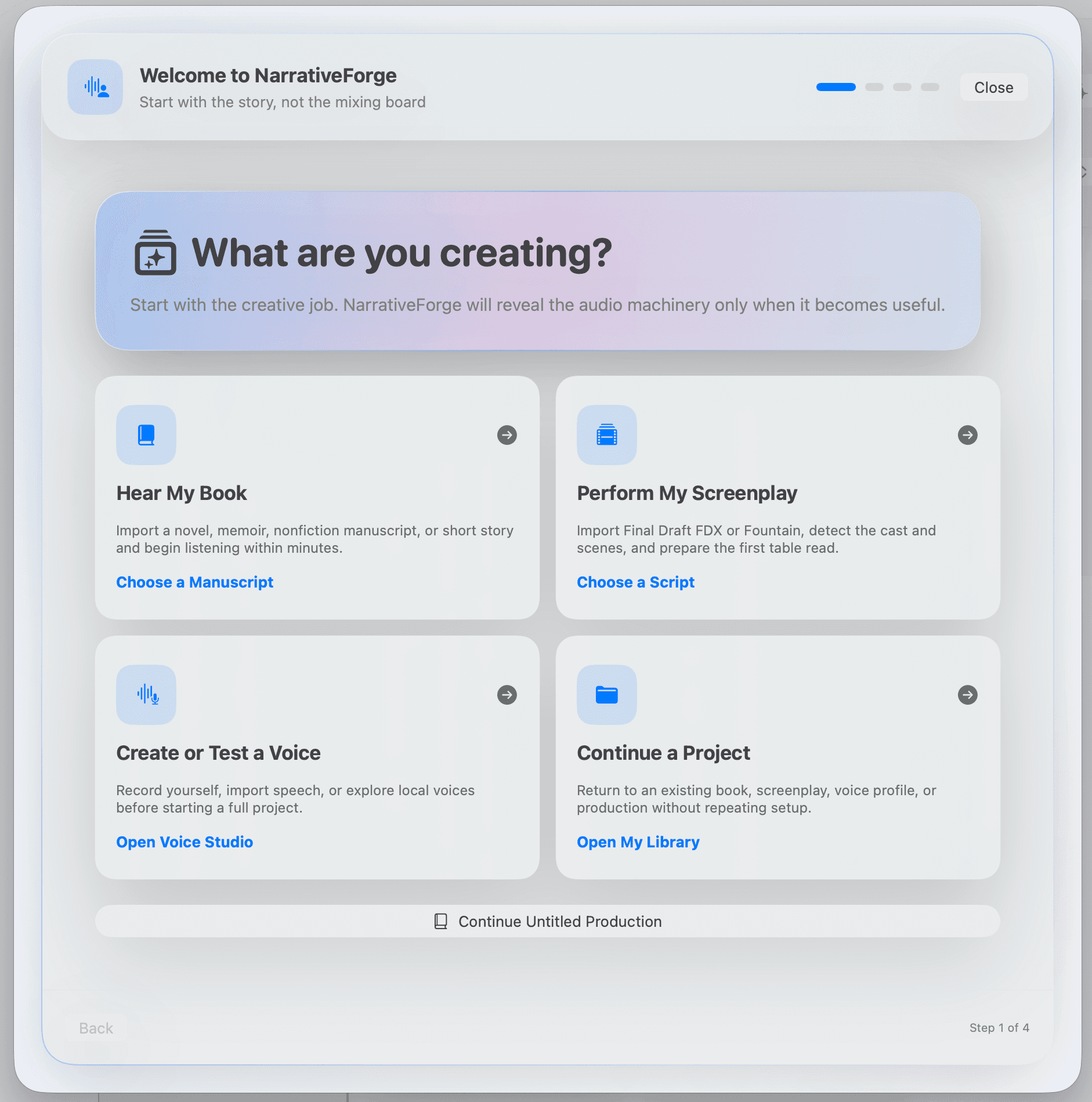
Current development capture
Start with the creative job, not the mixing board.
The opening experience immediately frames the work in creative terms: book, screenplay, voice, or project continuation. It signals the product's simplifying instinct and avoids pushing users into studio complexity before it becomes useful.
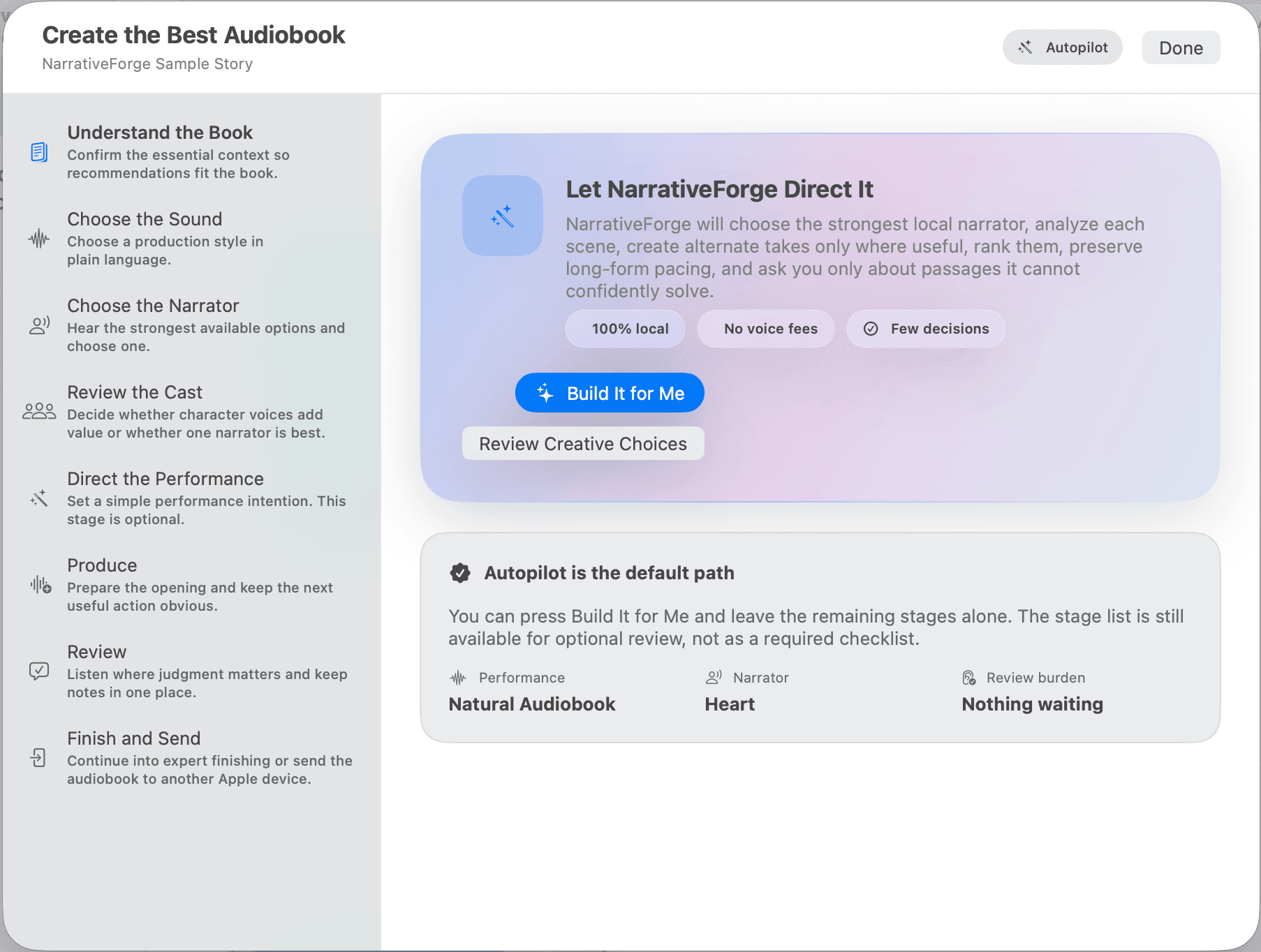
Audiobook Studio
Autopilot can carry the obvious decisions and leave judgment in your hands.
This screen grounds the audiobook promise in a concrete workflow: understand the book, choose the sound, cast the narrator and voices, direct the performance, and produce the result without turning the process into a technical chore.
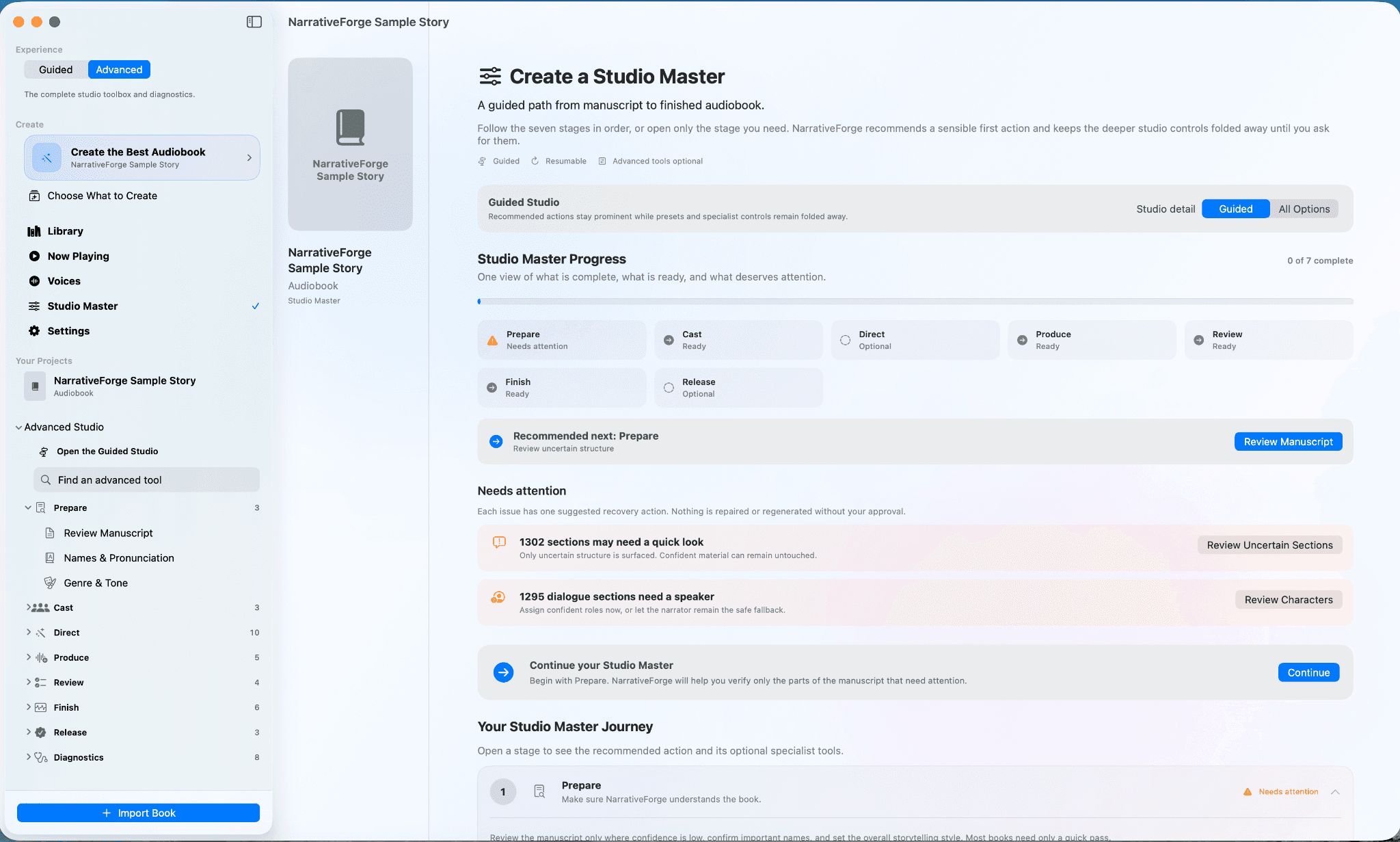
Guided Studio Master
A large project still needs a calm command center.
The Studio Master screen shows a richer layer of the product: progress across stages, surfaced uncertainty, recommended next actions, and a guided path that keeps deep controls available without making them mandatory.
True Table Read Studio
The cast shares the same dramatic moment.
Characters are designed to respond to scene context, stage direction, power shifts, and the timing around a line. Direct the beat, compare a new take, and continue without rebuilding the entire read.
The working sequence
From page to performance, then back to the page.
Import the work
Bring in an FDX screenplay, Fountain file, PDF, manuscript, or watched export without abandoning the writing tool that owns the draft.
Meet the cast
NarrativeForge identifies roles, suggests voices, and helps compare the ensemble inside the scene rather than in isolated auditions.
Hear the scene
The read follows dramatic context, cue timing, stage direction, interruptions, silence, and the emotional pressure moving through the exchange.
Direct the performance
Give a plain-language note to one line, a beat, a relationship, a character, or the remainder of the scene.
Revise the script
Return to Final Draft, Scrivener, Fountain, or the manuscript with evidence from the performance rather than a vague sense that something is off.
Keep the memory
Casting, pronunciations, director notes, and chosen takes remain attached while changed material is reconciled.
Export or rehearse
Continue listening, join the table read, prepare sides, develop an audiobook, or move selected audio into downstream production.
Natural-language directing
Give the note you mean, not the parameter you can find.
Select a line, beat, character, relationship, or scene, then direct in ordinary creative language. NarrativeForge is designed to change the acting while preserving the voice, change the voice while preserving the acting, or generate alternate interpretations for comparison.
“Less angry. She already knows, and the confirmation hurts more than the lie.”Explore the director workflow
Give the final word more silence.
AppliedLet him interrupt before she finishes.
AppliedThey have survived this argument before.
AppliedKeep the tension underneath the politeness.
AppliedShe masks fear with dry precision around Elias.
AppliedRevision intelligence
The draft changes. The production does not forget.
Designed links for Final Draft and Scrivener identify changed material, preserve cast and direction, and mark only affected performances for new takes.
Final Draft Live Link · Designed workflow
Draft 7 compared with Draft 6
Casting and chemistry
A convincing voice is not automatically the right cast.
Audition inside the scene, compare ensemble balance, and retain the reasoning behind the choice. Character age, texture, energy, accent, dramatic function, and relationship all belong in the decision.
Character profile
Elias North
Late 30s · former idealist · conceals apology behind precision.
Voice auditions
Chemistry reasoning
Avery with Mara
Best contrast with Mara; restraint holds under pressure.
Built around the people doing the work
One studio, several creative rooms.
The core system remains consistent, but the questions change with the role: does the dialogue work, can the scene support this interpretation, can I rehearse my cues, can the voice remain stable across thirty chapters?
Pronunciation · Voice · Direction · Approved take
Audiobook Studio
Build the book as a performance, not a batch of chapters.
Develop narrator and character voices, direct scenes, manage pronunciation, preserve long-form consistency, and generate exportable production audio. The same system that understands a screenplay exchange can help hold an ensemble together across a novel.
Explore Audiobook StudioLocal-first privacy
The rehearsal room should have a door.
Unpublished work, custom voices, and performance decisions deserve precise controls. NarrativeForge prioritizes local processing wherever technically possible, visible disclosure before optional cloud use, user-controlled files, and retained consent and provenance for custom voices.
Read the privacy architectureWrite where you already write
Bring the format. Keep the authorship.
Compatibility is presented as an evolving development target, not a blanket promise. Structured formats receive the richest import and revision behavior; document formats receive an explicit recognition report.
Questions before the first read
Clear answers, including what is not public yet.
NarrativeForge is an AI Performance Studio in development for writers and directors. It is designed to combine virtual casting, scene-aware table reads, natural-language direction, rehearsal, revision memory, voice creation, and audiobook development in a private Mac-first environment.
NarrativeForge is in private development. The website presents the mature product direction while labeling planned or in-development capabilities. No public release date has been announced.
No. It is designed for private iteration, preparation, rehearsal, and rapid comparison. Human actors and live rooms remain uniquely valuable for interpretation, collaboration, and discovery.
Local-first processing is a core product direction wherever technically possible. Optional cloud boundaries, retention, deletion, and data-use details will be disclosed feature by feature before public release.
The intended compatibility path includes Final Draft FDX, Fountain, Scrivener exports, PDF, DOCX, RTF, TXT, and EPUB, with fidelity and revision behavior documented as each workflow matures.
Private beta
Your script already knows how it wants to sound. Come help us build the room where you can hear it.
Join the role-aware list for product updates and future beta invitations. No invented launch date, no exhausting application.